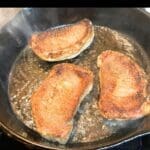
Juicy Thin Pork Chops Every Single Time
Learn how to cook thin pork chops without drying them out. This easy recipe delivers juicy, flavorful pork chops in under 15 minutes with simple ingredients.
Servings: 4 Servings
Calories: 66kcal
As an Amazon Associate I earn from qualifying purchases.
Kitchen Essentials


Ingredients
- 4 Thin Pork Chops boneless or bone-in
- 2 Tablespoons Olive Oil or butter or half butter and half olive oil
- 1 Teaspoon Salt
- ½ Teaspoon Black Pepper
- ½ Teaspoon Garlic Powder
- ½ Teaspoon Onion Powder
text ingredients
Instructions
- Prepare the Pork Chops. Pat the pork chops completely dry with paper towels. Moisture on the surface creates steam instead of a sear, and steam means no crust. Season both sides generously with salt, pepper, garlic powder and onion powder. Don't be shy with the salt. It pulls flavor to the surface and helps with browning.4 Thin Pork Chops, 1 Teaspoon Salt, ½ Teaspoon Black Pepper, ½ Teaspoon Garlic Powder, ½ Teaspoon Onion Powder
- Heat the Pan. Place a large skillet over medium-high heat and add 1 to 2 tablespoons of olive oil or butter. Let it heat until it shimmers or the butter stops foaming. If the oil isn't hot enough, the chops will stick and steam instead of sear. You want that immediate sizzle when the meat hits the pan.2 Tablespoons Olive Oil
- Cook the Pork Chops. Lay the pork chops in the skillet in a single layer without crowding. They should have space between them, or the temperature will drop and you'll lose your sear. Cook for 2 to 3 minutes without touching them. No pressing, no flipping, no peeking. Let the heat do its job. You'll know they're ready to flip when the edges start to turn opaque and the bottom releases easily from the pan.
- Flip and Finish Cooking. Turn the pork chops with tongs and cook the second side for another 2 to 3 minutes. You're looking for a deep golden-brown crust on both sides and an internal temperature that's climbing toward 145 degrees. If your chops are especially thin (under half an inch), you might only need 90 seconds per side. Watch the color and trust your thermometer.
- Check the Temperature. Insert an instant-read thermometer into the thickest part of the chop. Pull them off the heat the moment they hit 145 degrees. They'll look slightly pink in the center, and that's exactly right. Carryover cooking will bring them up to 150 during the rest, and that's where the magic happens.
- Rest Before Serving. Transfer the pork chops to a plate and let them rest for 3 to 5 minutes. Resting allows the muscle fibers to relax and reabsorb the juices that got pushed to the center during cooking. Cut into them too early and all that moisture ends up on your plate instead of in your mouth.
Your Own Private Notes
Notes
How to Know It's Done
Temperature is the only thing you can trust when you're cooking thin pork chops. Visual cues help, but they don't tell the whole story, and guessing is how you end up with dry meat. The golden crust. Both sides should be deeply browned with crispy edges. If the chop is pale or grayish, it's been steamed, not seared. If it's charred black, your heat was too high or you left it on too long. The firmness test. Press the center of the chop with your finger. It should feel firm but still have a little give, like pressing the fleshy part of your palm below your thumb when your hand is relaxed. If it feels rock-hard, it's overcooked. If it's squishy, it's not done. The color check. When you cut into a properly cooked thin pork chop, the center should be pale pink or just barely white. It should not be gray all the way through. Gray pork is dead pork. Pink pork at 145 degrees is safe, juicy, and delicious. The thermometer truth. Use an instant-read thermometer and pull the chops at exactly 145 degrees. Not 150. Not 160. Not when they "look done." The USDA says 145 is safe, and it's also the only temperature that keeps thin pork chops from turning into leather. If you nail the temperature and let them rest, everything else falls into place. If you skip the thermometer, you're gambling every single time.Nutrition
Calories: 66kcal | Carbohydrates: 1g | Protein: 0.3g | Fat: 7g | Saturated Fat: 1g | Polyunsaturated Fat: 1g | Monounsaturated Fat: 5g | Cholesterol: 1mg | Sodium: 582mg | Potassium: 14mg | Fiber: 0.1g | Sugar: 0.03g | Vitamin A: 1IU | Vitamin C: 0.1mg | Calcium: 3mg | Iron: 0.1mg
Tried this recipe? Share a photo and tag us — we can't wait to see what you've made! @patternprincess1 or tag #Patternprincess!
A few of my favorite things
The Power of Positivity