
Last updated on June 13th, 2026 at 10:05 am
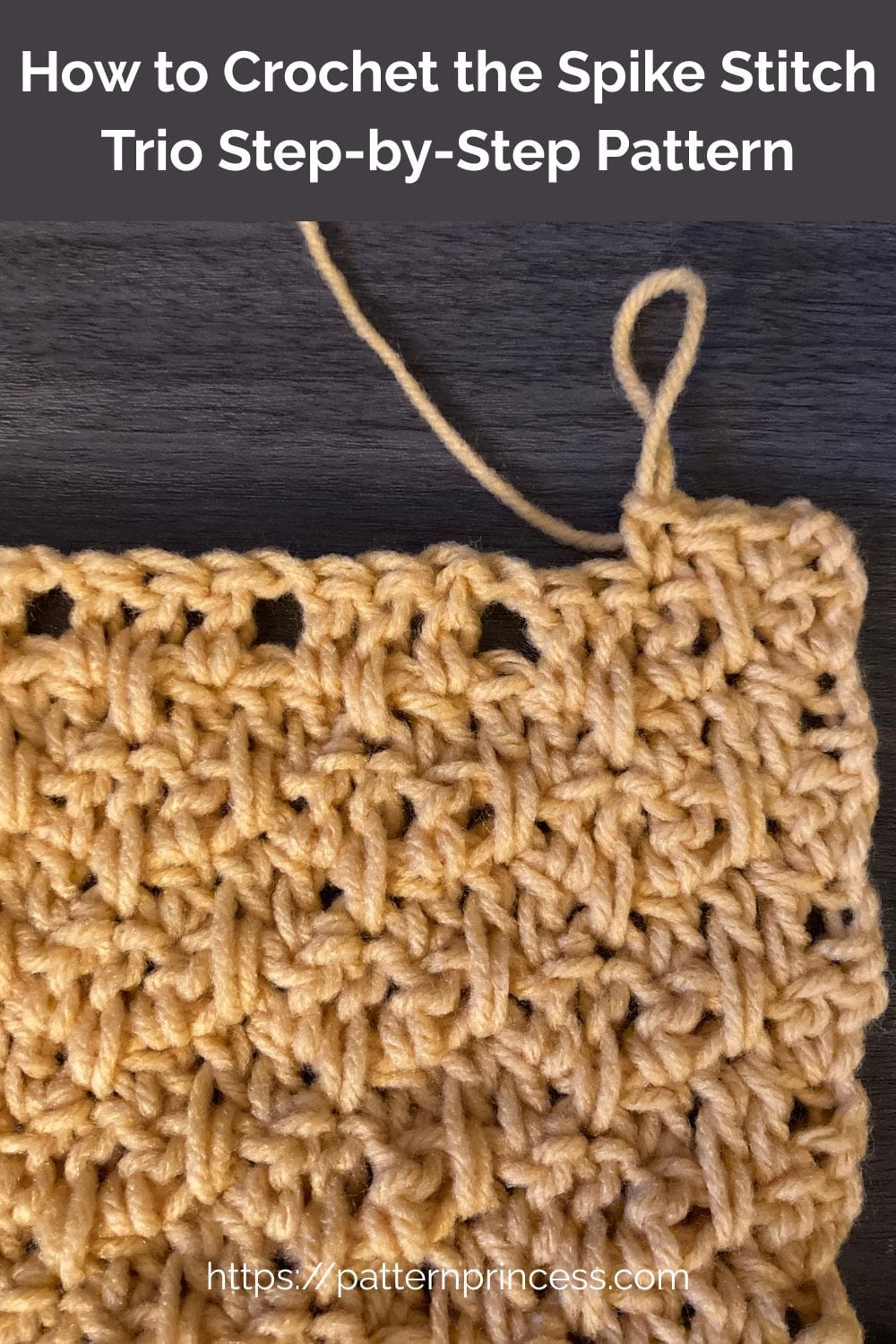
Introducing the Spike Stitch Trio, a brand‑new crochet stitch that blends structure, texture, and effortless rhythm. This stitch uses a combination of double crochet, double crochet spike stitch, and a simple ch‑1 skip‑1 repeat to create a dense, modern fabric with a gentle drop‑stitch effect.
With its three‑stitch pillar and subtle drop effect, it creates a fabric that looks intricate but works up quickly.
New Crochet Stitch
Have you ever stumbled into a stitch by accident — only to realize you’ve created something completely new? That’s exactly how the Spike Stitch Trio was born. What started as a simple experiment with double crochets and extended stitches turned into a beautifully structured, rhythmic texture with a subtle “drop” effect and no gaps.
It’s dense, modern, and wonderfully satisfying to work. Today I’m sharing the stitch definition, the repeat, and why this trio of stitches has quickly become one of my favorite discoveries on the hook.
If you love stitches that look intricate but are easy to memorize, this one is going to be a favorite.
In this tutorial, we’ll walk you through the stitch definition, step‑by‑step instructions, and tips for getting the best results. We’re excited to share this new stitch with you.
This stitch is a perfect blend of simple technique and eye‑catching results.
What Yarn Works with the Spike Stitch Trio?
Here’s the fun part. The Spike Stitch Trio is one of those rare stitches that plays beautifully with both yarn weight and color. Because the texture is structured but not overly busy, you get a lot of flexibility. Let’s break it down so you can confidently recommend yarns in your blog post or pattern.
Yarn Weights That Work Best
Worsted (Weight 4) — the sweet spot
- Shows the stitch trio clearly
- Gives great drape without losing stitch definition
- Perfect for blankets and more
DK (Weight 3) — crisp and elegant
- Makes the columns more delicate
- Great for garments, baby blankets, shawls
- The stitch definition becomes chef’s kiss clean
Bulky (Weight 5) — cozy and dramatic
- The trio stitches become bold and architectural
- Works well for winter throws or textured scarves
- Avoid overly fuzzy bulky yarns (they swallow the detail)
Super Bulky (Weight 6) — only if you want bold texture
- The stitch becomes very chunky
- Best for quick blankets or home décor
- Use smooth yarns only
Yarn Color Choices: What Looks Best
The stitch creates:
- Gentle color steps
- Natural striping that doesn’t look harsh
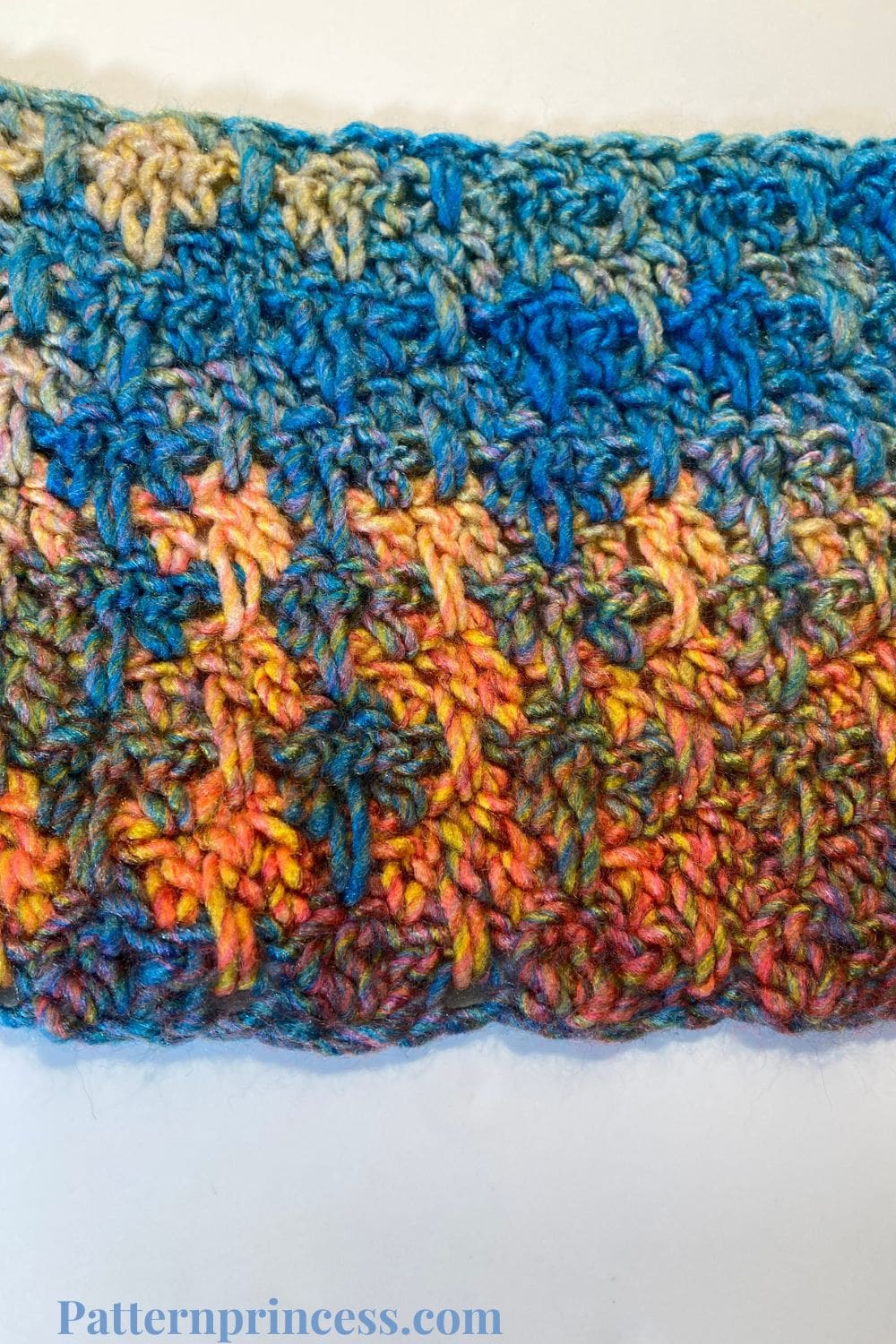
Variegated Yarn — Excellent choice
Variegated yarn works beautifully because:
- The trio stitches break up pooling
- The vertical texture creates soft color “waves”
- The drop stitch adds movement to the color changes
Best types of variegated:
- Long‑color‑change yarns (ombre, gradient, self‑striping)
- Muted watercolor variegated
- Earthy or sunset blends
Avoid:
- High‑contrast speckles (they can hide the trio structure)
Solid Colors — clean and modern
If you want the stitch itself to be the star:
- Solids make the trio texture pop
- Great for tutorials and stitch libraries
- Best in mid‑tone colors (not too dark, not too pale)
Heathers & Tweeds — soft and cozy
These yarns add:
- Depth without distraction
- A rustic, warm vibe
- Perfect for fall/winter blankets
What we love most about this stitch is how versatile it is. It works beautifully for blankets, scarves, and even borders, and you can easily adjust the size depending on your project.
Get Your Ad Free Printable PDF in our Etsy Shop.
About the Stitch
The Spike Stitch Trio gets its name from the grouping of stitches that create a “trio” effect, anchored by a longer spike stitch worked two rows below. These spikes add vertical definition and break up the rows in a really satisfying way, giving the fabric extra depth and dimension.
Two Different Starting Options in the Pattern
We’ve also included two different starting options in the pattern—one that’s perfect for standalone pieces, and another that creates a solid foundation if you plan to add a border later on.
When to Use Each Starting Option
This pattern includes two different starting options, depending on your project:
- Option 1:
Best for projects where the edge will remain as-is. It creates a lighter, more open foundation. - Option 2:
Ideal if you plan to add a border. The initial row of double crochet creates a more solid edge, helping prevent gaps and making it easier to work into later.
Project Ideas
The Spike Stitch Trio is a versatile stitch that works well for a variety of projects, including:
- Cozy blankets and throws
- Scarves and cowls
- Baby blankets
- Pillow covers
- Textured borders on larger projects
Grab your yarn and hook, and let’s get started!

Directions: Spike Stitch Trio Crochet Stitch
Skill Level
Advanced Beginner to Intermediate Crocheter
You should be comfortable with the double crochet stitch and working stitches two rows below.
Gauge
The gauge will depend on the yarn and crochet hook used.
Size
The size depends on the number of chain stitches and rows crocheted.
Varying the Size
There are two options for working this pattern.
- Option 1 has a stitch multiple of 4 + 1.
- Option 2 has a stitch multiple of 4.
Materials
This pattern works well with light or medium weight yarn.
Crochet hook recommended on yarn package. Normally a Size H crochet hook 5.0mm or Size I crochet hook 5.5mm
Scissors
Yarn Needle
Stitch Markers
Measuring Tape
Stitch Abbreviations (US Terms)
- CH = Chain
- DC = Double Crochet
- DC Spike = Double Crochet Spike Stitch
- SC = Single Crochet
- SK = Skip
- SP = Space
- ST = Stitch
- STs = Stitches
- YO = Yarn Over
- [ ] = Repeat Between
Pattern Notes
This pattern is written in U.S. Crochet Terms.
Turn at the end of each row.
When the spike stitch is noted to be worked, work long double crochet into the middle stitch from 2 rows below.
Video Tutorial Links are after the written pattern.

Tips Before You Start
Optional, but very helpful.
- Keep your tension relaxed when working the spike stitches so the fabric doesn’t pucker.
- When working into stitches two rows below, make sure to pull up your loop to the height of your current row.
Crochet Stitches
Chain Stitch (CH ST)
Begin the chain stitch by making a slip knot on the crochet hook. Leave about a 5-inch tail on the yarn. This will be weaved in later.
Next snug up the yarn loop that is on the crochet hook; while it should be firm, it should also be loose enough to slide on the hook with ease.
Keeping the loop on the hook, yarn over and draw the yarn through the loop. (The first chain stitch is complete). Continue making your desired number of chain stitches.
Double Crochet (DC)
Yarn over, insert hook through a stitch and pull up a loop. Next, yarn over and pull through two loops on the hook. Lastly, yarn over again and pull through the last two loops on the hook.
Single Crochet (SC)
Insert the hook in a stitch pull up a loop. Yarn over and pull through the two loops on the hook.
Special Stitches
Double Crochet Spike Stitch. Yarn over, insert hook into indicated stitch or space 2 rows below and pull up a loop (3 loops on hook), yarn over, pull through 2 loops, yarn over, pull through remaining 2 loops.
Begin Crochet Pattern
This pattern includes two different options for the starting rows.
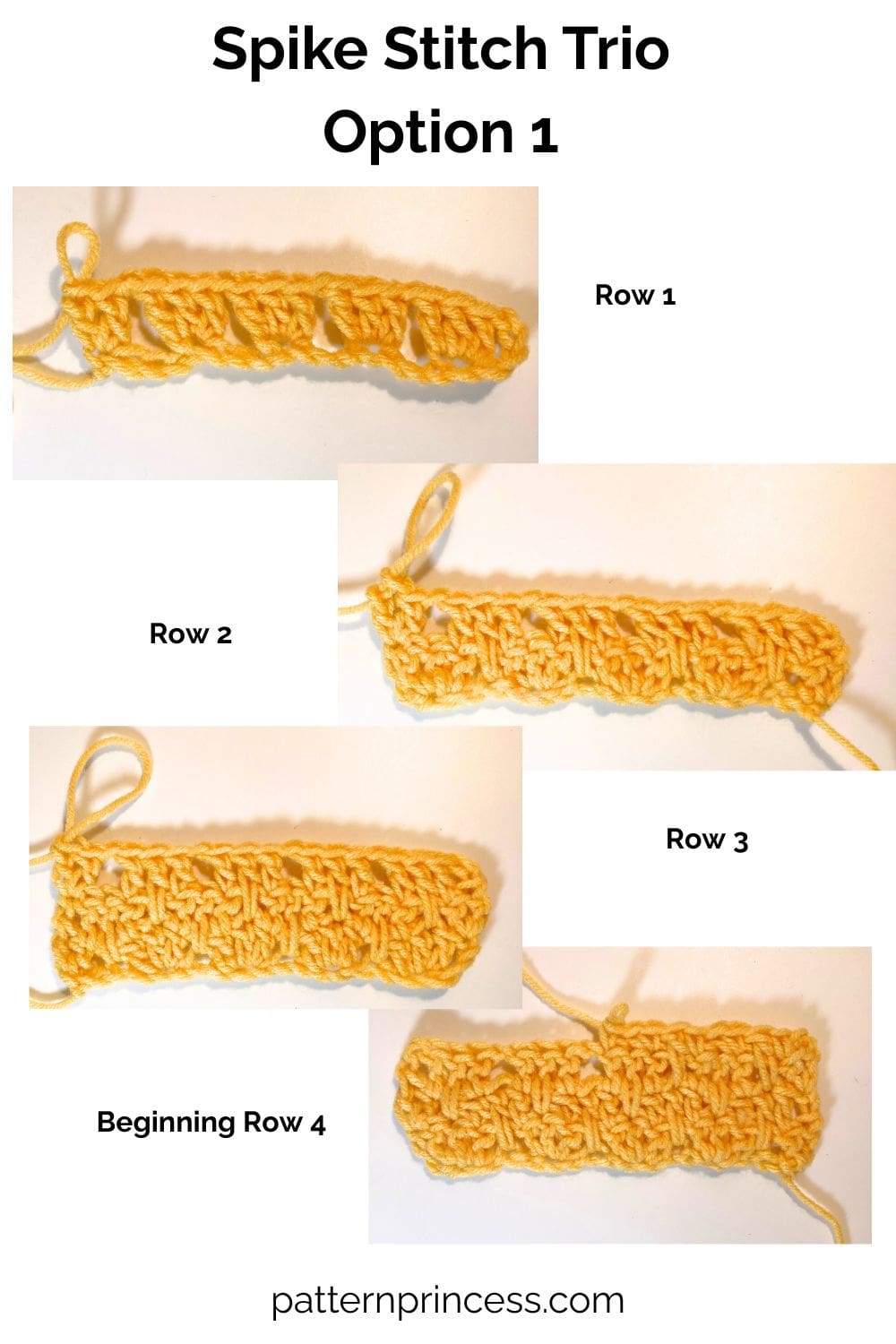
Option 1
This is nice for a pattern where you do not plan on adding a crochet border.
This option uses a multiple of 4 + 1.
Begin the chain stitch by making a slip knot on the crochet hook.
Chain 21
Row 1
3 DC in the 5th CH from the hook. CH 1, [SK 3 CH STs, 3 DC in the next CH ST, CH 1]. Repeat between [ ] across. When there are 4 STs left, CH 1, SK 3 STs and work 2 DC in the last ST. Turn.
Row 2
CH 2 (Counts as DC). 1 DC in next st, 1 DC Spike ST (worked in the middle skipped CH SP below), 1 DC in next ST. [CH 1, SK 1 ST, 1 DC in next ST, 1 DC Spike ST worked in the CH SP below, 1 DC in next ST]. Repeat between [ ] across. When there are 3 STs left CH 1, SK 2 STs and end with 2 DC in the last ST. Turn
Row 3
CH 2 (Counts as DC). 1 DC in next st, 1 DC Spike ST (worked in the skipped ST 2 rows below), 1 DC in next ST. [CH 1, SK 1 ST, 1 DC in next ST, 1 DC Spike ST, 1 DC in next ST]. Repeat between [ ] across. When there are 3 STs left CH 1, SK 2 STs and end with 2 DC in the last ST. Turn
Rows 4 and Beyond
Repeat row 3.
Final Row (optional)
To help create less of a gap between the stitches in the final row, you can work a single crochet on each side of the double crochet spike stitch rather than a double crochet on either side.
CH 1 (Counts as a SC). 1 SC in next ST, 1 DC Spike ST, 1 SC in next ST. [CH 1, SK 1 ST, 1 SC in next ST, 1 DC Spike ST, 1 SC in next ST]. Repeat between [ ] across. When there are 3 STs left CH 1, SK 2 STs and end with 2 SC in the last ST. Turn
Finishing
Cut off yarn leaving about a 10-inch yarn tail. Pull through the last loop to secure. Weave in the yarn tail using the tapestry needle. Cut off the excess yarn.
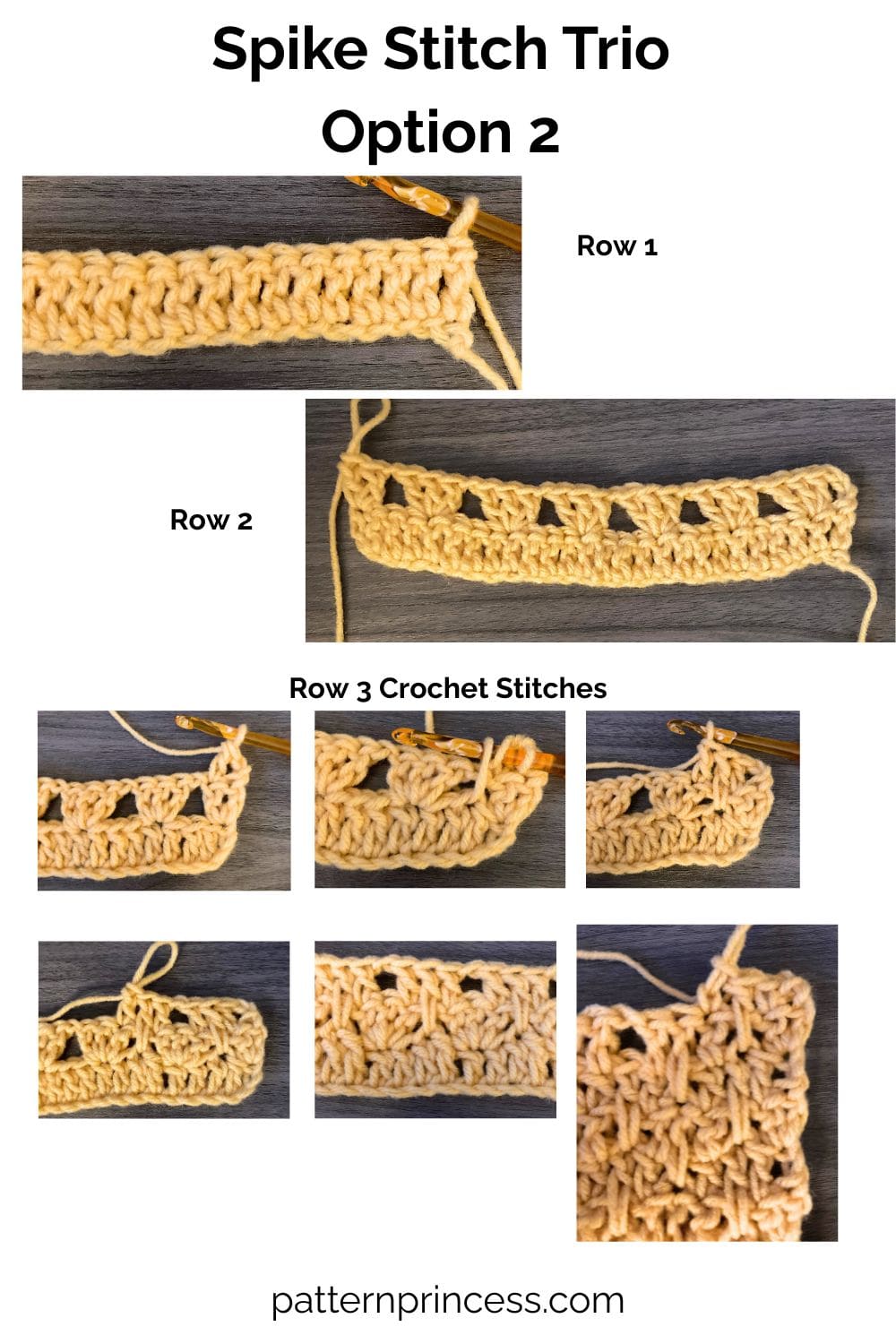
Option 2
This option has a row of double crochet stitches for the first row. It is great for adding stability to the first row so there are no gaps when adding a border.
This option uses a multiple of 4.
Begin the chain stitch by making a slip knot on the crochet hook.
Chain 20
Row 1
In the 4th CH from the hook work a DC and in each ST across. Turn
Row 2
CH 3 (Counts as DC). 3 DC in the next ST. [CH 1, SK 3 STs, 3 DC in the next ST]. Repeat between [ ] across. When there are 4 STs left CH 1, SK 3 STs, 2 DC in the last ST. Turn
Row 3
CH 2 (Counts as DC). [1 DC in next ST, 1 DC Spike ST (worked in the DC ST 2 rows below), 1 DC in next ST. CH 1, SK 1]. Repeat between [ ] across. When there are 3 STs left CH 1, SK 2 STs, 2 DC in the last ST. Turn
Rows 4 and Beyond
Repeat row 3.
Final Row (optional)
To help create less of a gap between the stitches in the final row, you can work a single crochet on each side of the double crochet spike stitch rather than a double crochet on either side.
CH 1 (Counts as a SC). 1 SC in next ST, 1 DC Spike, 1 SC in next ST. [CH 1, SK 1 ST, 1 SC in next ST, 1 DC Spike ST, 1 SC in next ST]. Repeat between [ ] across. When there are 3 STs left CH 1, SK 2 STs and end with 2 SC in the last ST. Turn
Finishing
Cut off yarn leaving about a 10-inch yarn tail. Pull through the last loop to secure. Weave in the yarn tail using the tapestry needle. Cut off the excess yarn.
Video Tutorials on our YouTube Channel
Spike Stitch trio right hand video tutorial
Spike Stitch Trio left hand video tutorial
We hope that you have enjoyed this lovely crochet pattern. Here are a few more crochet patterns to inspire your next project.

You can find Victoria crocheting, quilting, and creating recipes. She has cooked in restaurants for over 20 years, including many larger parties. She learned to crochet when she was just 11 years old and has been crocheting ever since; over 50 years now. Over 40 years ago, she loved her first class in sewing and continues to hone her skills in quilting. Many have enjoyed the handmade gifts over the years. In her professional career, she has worked in management in a wide variety of businesses including higher education as a dean of a division. All the while attending college part-time to achieve her doctorate in higher education with an emphasis in e-learning.