
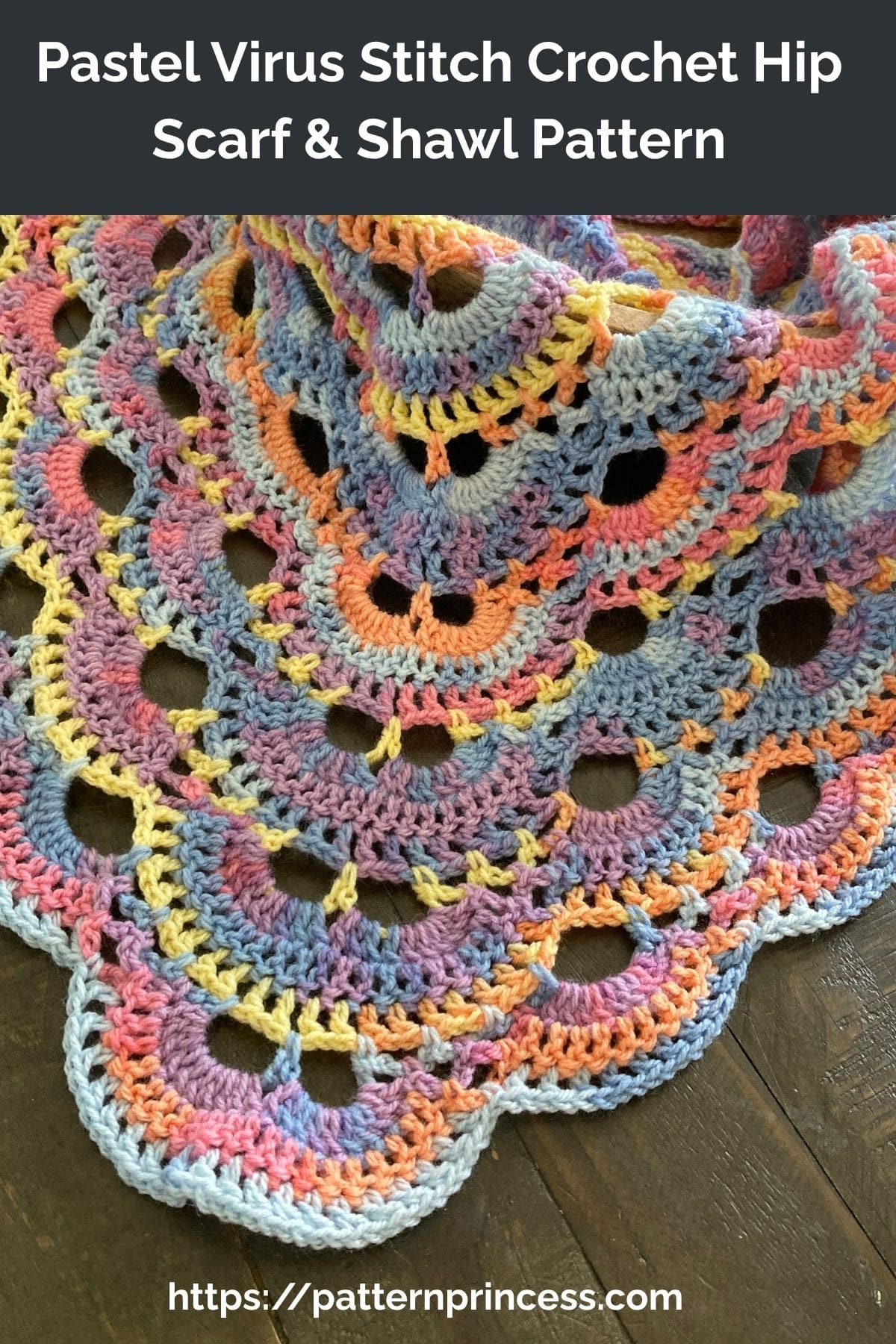
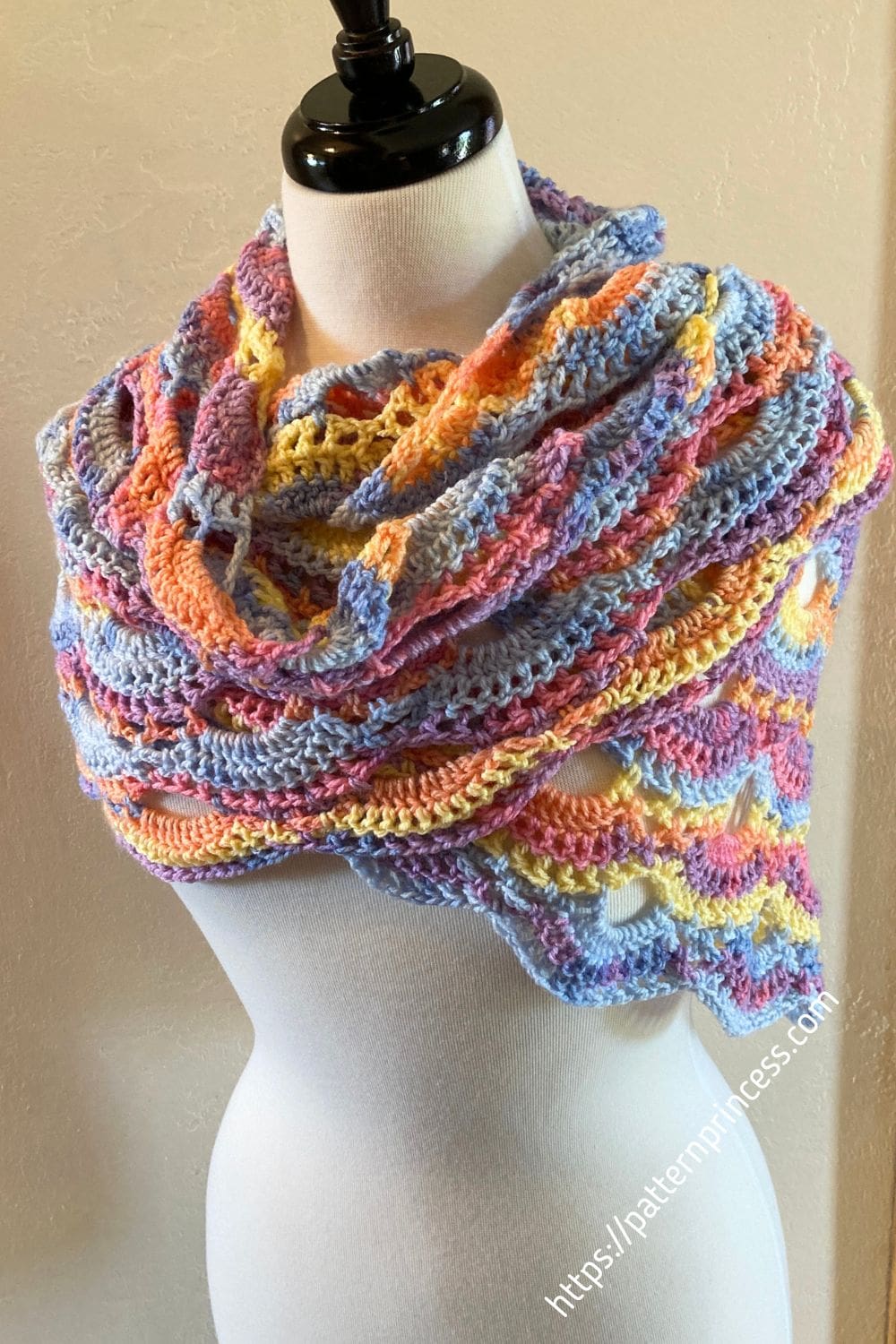
The Pastel Virus Stitch Crochet Hip Scarf & Shawl features the beautiful, open texture of the classic Virus Stitch worked in soft, dreamy pastel shades. The lacy fabric makes this a fun accessory to crochet and a versatile piece to wear.
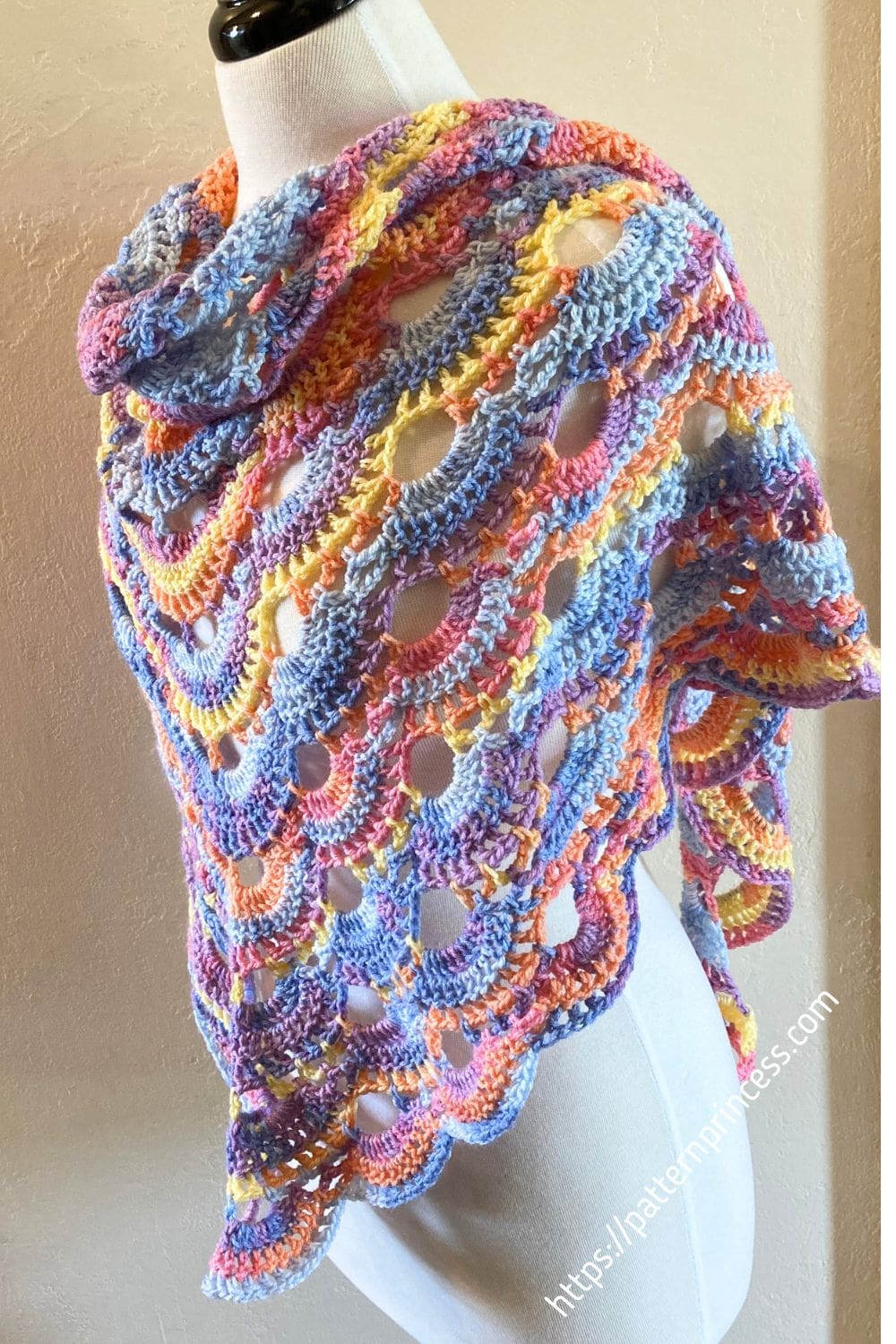
Designed in sixsizes from Small through XXX-Large, this accessory can be worn as a hip scarf, draped over the shoulders as a shawl, or wrapped around the body for a lightweight layer. The open stitch pattern gives it plenty of drape and movement, making it especially pretty when worn over a simple outfit.
The sample shown here is worked from the top down using Lion Brand Ice Cream in the color Parfait. The soft pastel color changes create a beautiful striped effect as the Virus Stitch grows, adding visual interest without the need to change colors throughout the pattern.
What Is the Virus Stitch?
The Virus Stitch isn’t a single stitch but a four‑row crochet repeat that creates a beautifully expanding, fan‑shaped lace pattern. Each repeat builds on the previous one. One of the reasons it’s often compared to something that “spreads” outward.
How the Repeat Works
- Begin with a central motif.
- Work a 4‑row cycle that adds new fans or shell clusters along the edges.
- Continue repeating these rows to grow the piece to any size—shawls, ponchos, and accessories all use this structure.
Why Makers Love It
The Virus Stitch is popular for its:
- Striking fan-shaped texture.
- Easy scalability—just keep repeating the row set.
- Accessibility for a wide range of skill levels.
And while the name may sound intimidating, don’t let it scare you away. Once you learn the repeating sequence and understand where each section begins and ends, the stitch becomes much easier to work.
Why You’ll Love This Pattern
- Six sizes to choose from – Make a petite Small or go all the way up to XXX-Large for more generous coverage and drape.
- Perfect for pretty color-changing yarns – The expanding stitch pattern works beautifully with self-striping and variegated yarns, while a solid color lets the stitchwork take center stage.
- Beautiful Virus Stitch texture – The classic Virus Stitch creates an open, lacy fabric with a lovely flowing texture that makes this accessory special. As you crochet, the repeating pattern becomes intuitive and satisfying, growing in a graceful radiating rhythm that’s fun to watch unfold.
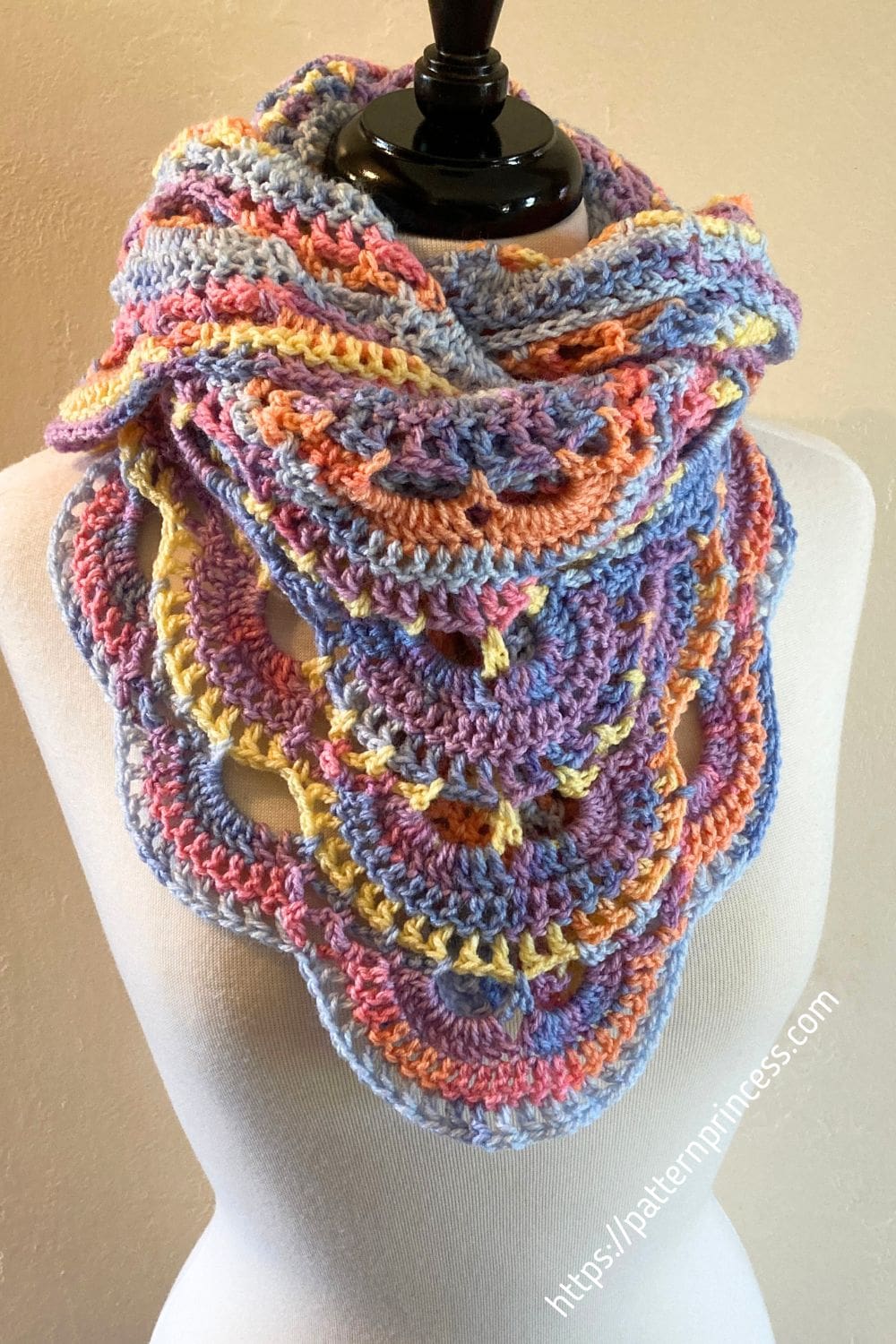
- So many ways to wear it – Tie it around your hips as a scarf, drape it over your shoulders as a shawl, or wrap it around your body for a lightweight layer.
- Video help for everyone – Right-handed and left-handed video tutorials are included, so you can follow along in the way that feels most comfortable to you.

Choosing Your Size
Because this is a tie- or wrap-style accessory, you have some flexibility when choosing your size. Rather than needing an exact fit like a fitted garment, consider how much coverage you would like and how you plan to wear your finished piece.
The six sizes are:
- Small – a petite, narrower option with less overall coverage
- Medium – an average size with moderate coverage
- Large – a fuller option with additional coverage
- X-Large – a larger size for more generous coverage
- XX-Large – an extended size with generous coverage
- XXX–Large – an extended size with the most overall coverage
If you plan to wear the piece primarily as a hip scarf, choose a size based on the amount of coverage you prefer around your hips. If you want to wear it more often as a shawl or wrap, you may prefer a smaller size for coverage and drape.
Yarn & Color
A smooth yarn with good stitch definition is a great choice when you’re first learning this stitch. It makes it easier to see where to place your hook and identify the individual stitches.
The sample is made with Lion Brand Ice Cream in Parfait, a soft pastel colorway that works beautifully with this crochet stitch. The gradual color changes highlight the expanding stitch pattern and give the finished scarf a soft, flowing look.
This pattern is not limited to self-striping yarn, though. For a more classic or elegant look, try a solid color. A solid shade will put more emphasis on the beautiful texture and the distinctive shape created by the stitch.
You may also want to consider:
- Medium-weight yarn (#4) for shawls, wraps, and hip scarves
- Lightweight yarn (#3) for a more delicate, drapey fabric
- Cotton or cotton blends for lightweight accessories
- Acrylic or acrylic blends for easy-care projects
- Variegated yarn for a more colorful, blended effect and effortless color changes
- Solid-colored yarn when you want the stitch pattern itself to be the star
- I would avoid very bulky yarns for this particular stitch

A Versatile Accessory
One of the things I love about this design is that it can be more than just a hip scarf.
Crochet Shawls, Scarves, and Wraps
The expanding nature of the stitch makes it a natural choice for triangular shawls or scarves. Use a lightweight yarn for a delicate accessory or a medium-weight yarn for a warmer wrap.
Crochet Hip Scarves
The stitch creates a beautiful, bohemian look for a hip scarf. Depending on the size you make, it can be worn around the hips over jeans, leggings, or a dress.
Crochet Beach Cover-Ups
The openwork design makes the Virus Stitch an interesting option for lightweight beach accessories and cover-ups.
Get Your Ad Free Printable PDF in our Etsy Shop.
Learn as you crochet – The pattern includes detailed, step-by-step written instructions along with photo tutorials to help you see exactly how the stitchwork comes together.
Directions: Pastel Virus Stitch Crochet Hip Scarf & Shawl
Skill Level
Intermediate Crocheter
Gauge
Approximately 16 stitches and 6 rows every 4 x 4 inches of pattern.
Size
- Small: 10 ½ X 22 ½ inches
- Medium: 20 ½ X 44 ½ inches
- Large (shown): 28 X 64 inches
- X-Large: 33 X 75 inches
- XX-Large: 38 X 86 inches
- XXX-Large: 43 X 97 inches
Depth: measured from the bottom point to the midpoint of the top edge.
Top width: measured straight across the top edge.
Abbreviations US Terms
- CH = Chain
- DC = Double Crochet
- SC = Single Crochet
- SK = Skip
- SL ST = Slip Stitch
- SP = Space
- ST = Stitch
- STs = Stitches
- [ ] = Repeat Between
Special Abbreviations
- CH-SP = Chain Space
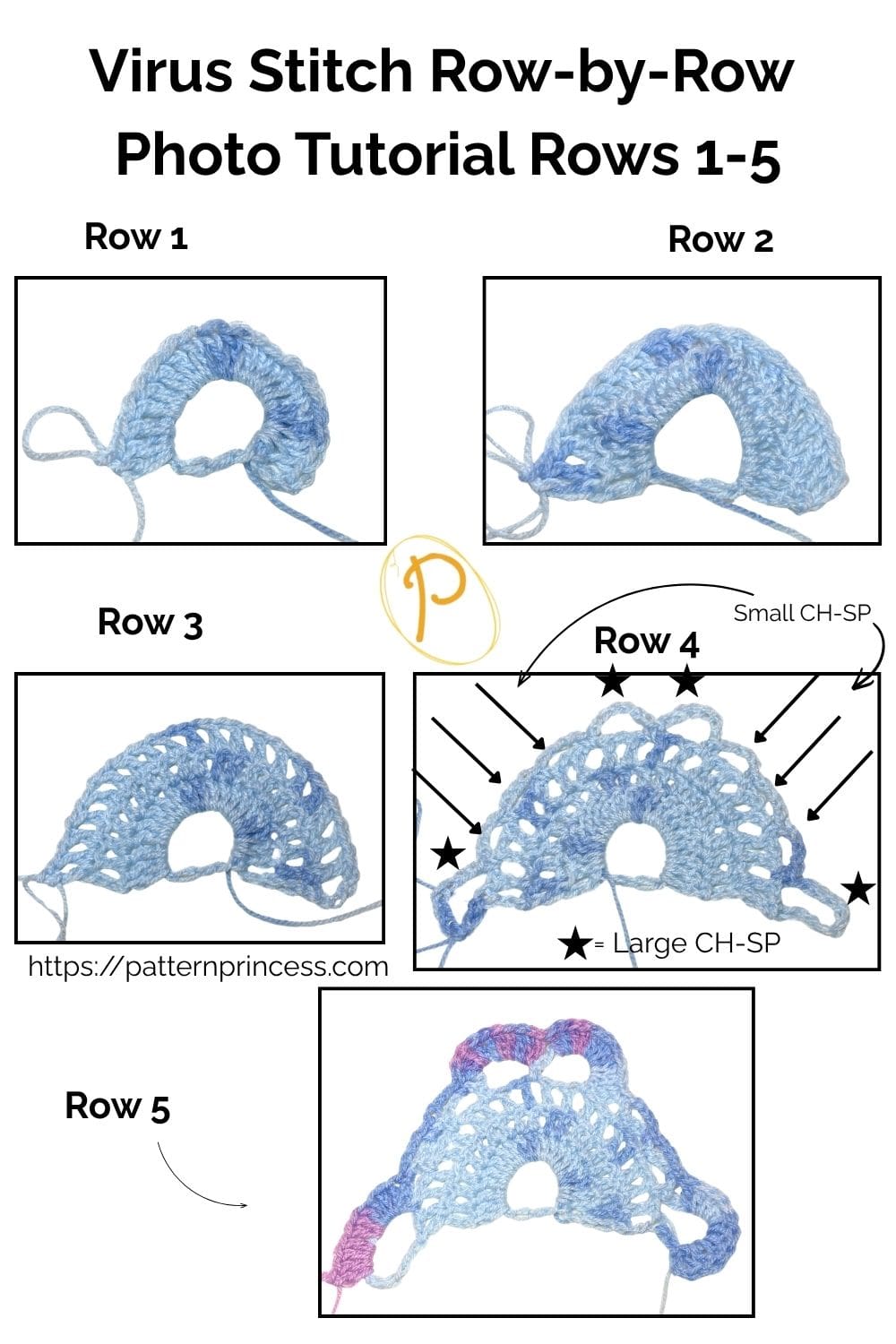
- Large CH-SP: The larger opening created by a longer chain, such as a chain-7 space.
- Small CH-SP: The smaller opening created by a shorter chain, such as a chain-4 space.

Materials
Lion Brand Yarns Ice Cream #3 weight 100% acrylic yarn. Each skein contains 394 yards.
Color: Parfait
- Small: 86 yards, 1 skein
- Medium: 335 yards, 1 skein
- Large (shown): 650 yards, 2 skeins
- X-Large: 910 yards, 3 skeins
- XX-Large: 1200 yards, 4 skeins
- XXX-Large: 1550 yards, 4 skeins
Size I Crochet Hook 5.5 mm
Yarn Needle
Scissors
Stitch Markers
Tape Measure
If you are not able to find the yarn locally, you can purchase it online. Savings Center – Pattern Princess
Pattern Notes
Written in US Terms.
Turn at the end of each row.
This triangular shawl is worked from the top down.
The shawl uses the classic 4‑row Virus Stitch repeat. Once you establish the first eleven rows, the pattern repeats Rows 8–11 to continue growing the shawl.
The stitch pattern expands outward in beautiful, flowing fans.
The shawl grows quickly — each repeat becomes wider, so your rows will naturally get longer as you go.
Blocking is recommended to open the lace and enhance drape.
Tips for Crocheting the Virus Stitch
Before you begin, here are a few tips that may make learning this stitch easier.
Take your time with the first few repeats. The stitch may feel confusing at first, but once you recognize the repeating sections, it becomes much easier to follow.
Use stitch markers. Marking important sections of your work can help you keep track of where you are in the pattern, especially while learning.
Pay attention to your increases. The stitch grows by adding stitches and expanding the repeating sections. Keeping track of where your increases belong will help your project maintain its shape.
Don’t crochet too tightly. A relaxed tension will help the openwork sections open up and make the stitch pattern easier to see.
Count your stitches when you’re learning. Once you’ve worked several repeats and feel comfortable with the pattern, you’ll likely be able to recognize the sections visually. But counting is a great way to catch mistakes early.
Use the video tutorial. Sometimes seeing exactly where the hook goes is easier than trying to interpret written instructions. We have included both right- and left-handed video tutorials to help you follow along.
Crochet Stitches
Chain Stitch (CH)
Begin the chain stitch by making a slip knot on the crochet hook. Leave about a 5-inch tail on the yarn. This will be woven in later.
Next snug up the yarn loop that is on the crochet hook; while it should be firm, it should also be loose enough to slide on the hook with ease.
Keeping the loop on the hook, wrap the yarn over the crochet hook from back to front. Draw the yarn through the loop. You’ve just made a chain stitch. Yarn over again and draw the yarn through the loop on the hook. Continue yarning over and drawing the yarn through the loop on the hook to make more chain stitches.
Double Crochet (DC)
Yarn over, insert the hook in a stitch and pull up a loop. Next, yarn over and pull through two loops on the hook. Lastly, yarn over again and pull through the last two loops on the hook.
Single Crochet (SC)
Insert the hook in a stitch and pull up a loop. Yarn over and pull through the two loops on the hook.
Slip Stitch (SL ST)
Insert the hook in a stitch and pull up a loop and pull through the loop on the hook.
Begin Pattern
Size Instructions: All six sizes begin the same way and follow the same stitch pattern. The only difference is the number of rows worked to achieve the desired size.
- Small: 15 rows
- Medium: 31 rows
- Large (shown): 43 rows
- X-Large: 51 rows
- XX-Large: 59 rows
- XXX-Large: 67 rows
To make the hip scarf or shawl larger than the sizes listed, continue repeating Rows 8–11 until you reach your desired size.
Ch 10 and connect in a circle using a SL ST into the first ST. Turn
Row 1
Ch 3 (Counts as 1 DC), DC 19 into the circle (20 DC). Turn
Row 2
Ch 3 (Counts as 1 DC). 1 DC in each ST around (20 DC). Turn
Row 3
Ch 4 (Counts as 1 DC and 1 CH). 1 DC in next ST. [1 DC, CH 1]. Repeat between [ ] in each remaining ST to the end. small(20 DC) Turn.
Row 4
Ch 10 (Counts as 1 DC and 7 CH). SK 1 CH-SP and SC 1 in next CH-SP. [CH 4, skip 1 CH-SP, 1 SC in next CH-SP]. Repeat between [ ] twice for a total of 3 times. [CH 7, SK 1 CH-SP, 1 SC in next CH-SP]. Repeat between [ ] one more time for a total of 2 times. [CH 4, SK 1 CH-SP,1 SC in next CH-SP]. Repeat between [ ] twice for a total of 3 times. End with CH 7 and 1 DC in the 3rd CH ST. Turn
Row 5
Ch 3 (Counts as 1 DC). DC 9 into the Large CH-SP. 1 SC in next Small CH-SP. [CH 4, 1 SC in the next Small CH-SP]. Repeat between [ ] 1 time for a total of 2 times. 10 DC into the next Large CH-SP, 10 DC into the next Large CH-SP. 1 SC in the next Small CH-SP. [ CH 4 and 1 SC in the next Small CH-SP]. Repeat between [ ] 1 time for a total of 2 times. 10 DC into the last Large CH-SP. Turn
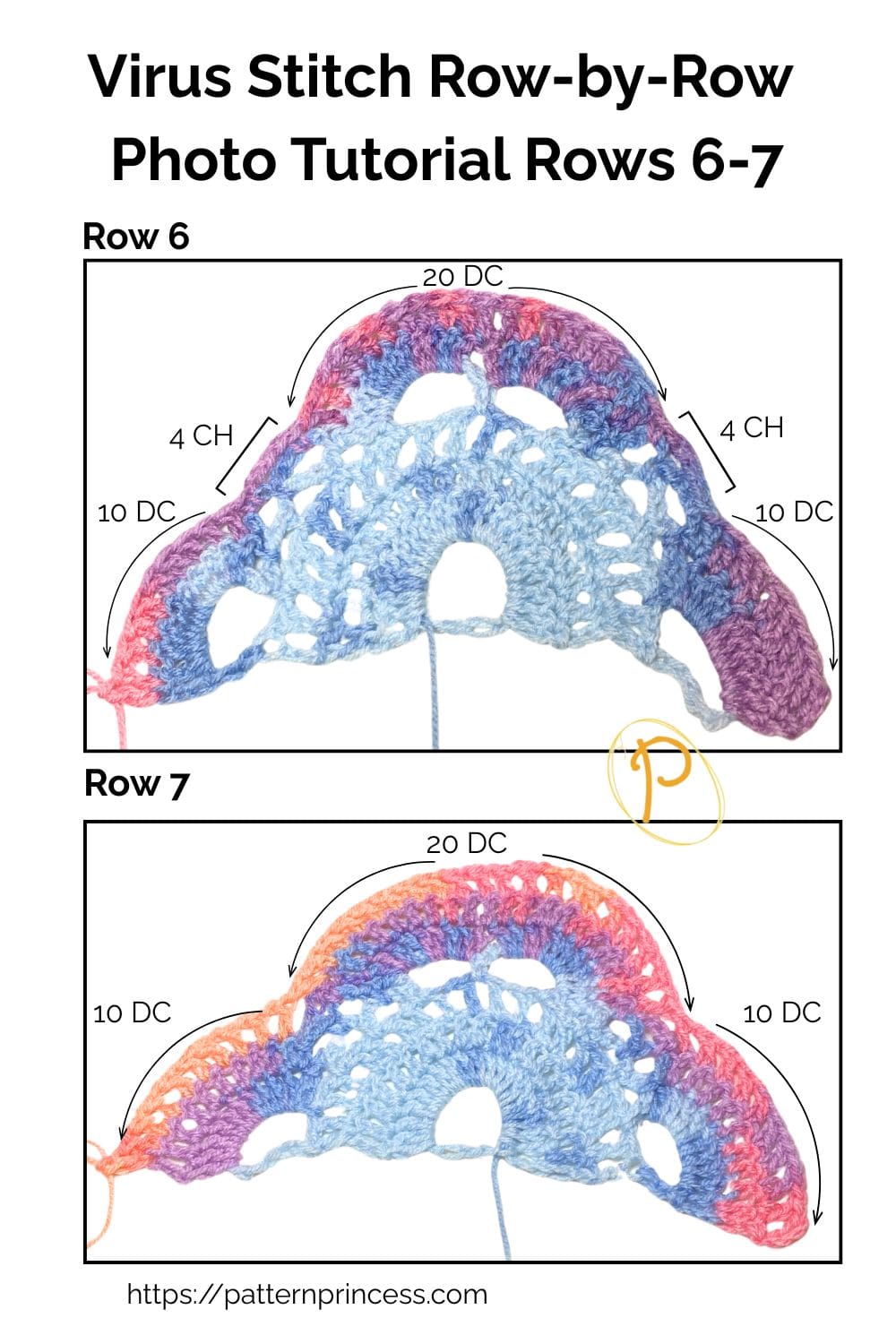
Row 6
Ch 3 (Counts as 1 DC). 1 DC in each of the next 9 STs of the Large CH-SP (10 DC). 1 SC in next Small CH-SP, CH 4, 1 SC in the next Small CH-SP.
Middle of row: 1 DC in each ST of the next 2 Large CH-SP (20 DC).
1 SC in next Small CH-SP, CH 4, 1 SC in the next Small CH-SP. 1 DC in each of the next 10 STs of the last Large CH-SP (10 DC). Turn
Row 7
Ch 4 (Counts as 1 DC and 1 CH). 1 DC in next ST, (CH 1, 1 DC) in all the DC STs of the Large CH-SP (10 DC).
Skip the Small CH-SP. 1 DC into the first ST of the next Large CH-SP. (CH 1, 1 DC) in all DC of the 2 Large CH-SP STs (20 DC).
Skip the Small CH-SP. 1 DC into the first DC of the last Large CH-SP. (CH 1, 1 DC) in all the remaining DC STs (10 DC). Turn
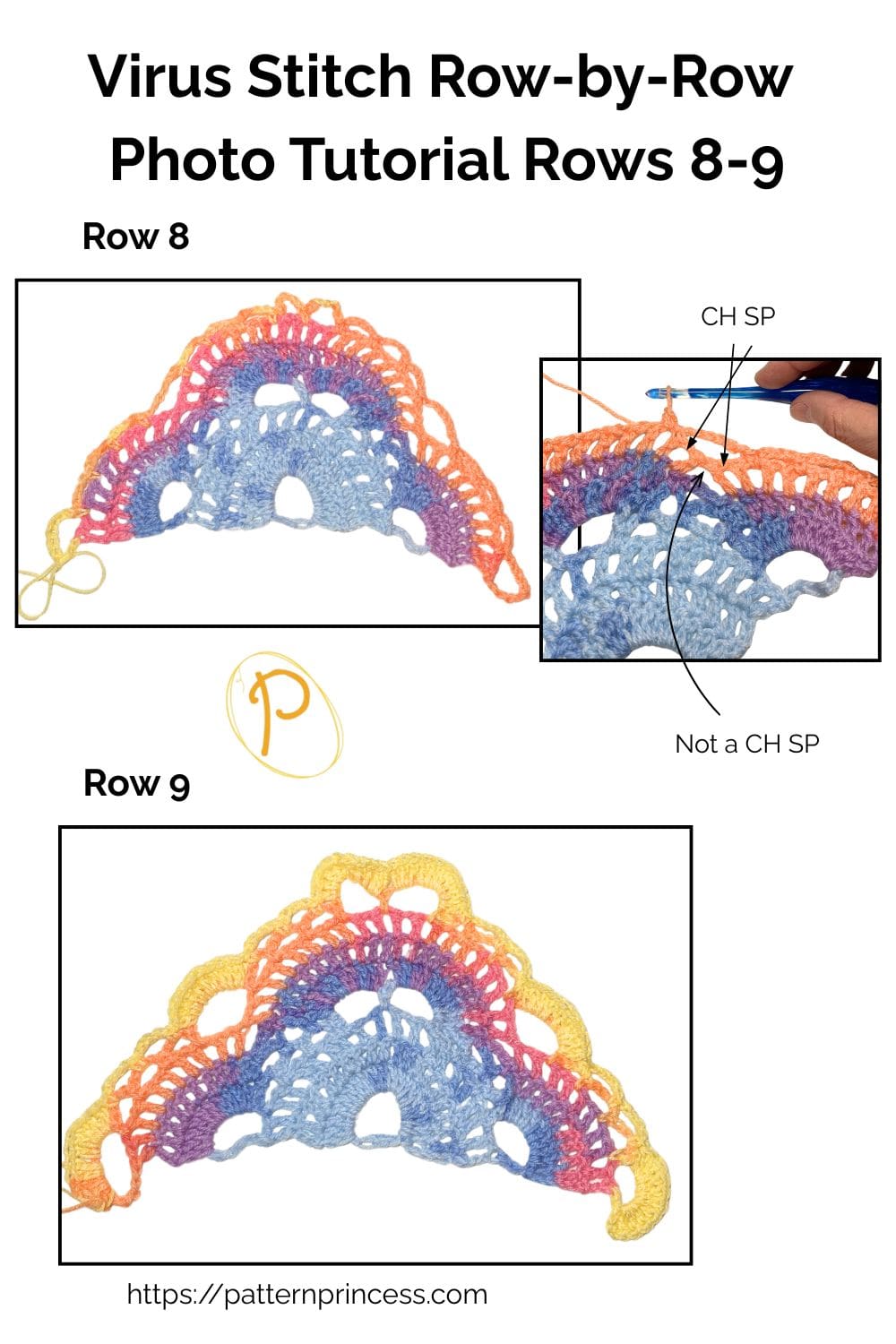
Row 8
Ch 10 (Counts as 1 DC and CH 7). SK 1 CH SP and 1 SC in next CH SP. [CH 4, SK 1 CH SP, 1 SC in the next CH SP] Repeat between [ ] 2 more times for a total of 3 times. (You should have 3 Small CH-SP). CH 7, SK 2 CH SP. 1 SC in the next CH SP. [CH 4, SK 1 CH SP, 1 SC in the next CH SP] Repeat between [ ] 2 more times for a total of 3 times. (You should have 3 Small CH-SP).
[CH 7, SK 1 CH SP, 1 SC in next CH SP]. Repeat between [ ] 1 more time for a total of 2 times. (You should have 2 Large CH-SP).
[CH 4, SK 1 CH SP, 1 SC in the next CH SP] Repeat between [ ] 2 more times for a total of 3 times. (You should have 3 Small CH-SP). CH 7, SK 2 CH SP. 1 SC in next CH SP. [CH 4, SK 1 CH SP, 1 SC in the next CH SP] Repeat between [ ] 2 more times for a total of 3 times. (You should have 3 Small CH-SP). CH 7 and 1 DC in the 3rd CH of the previous row CH-4. Turn
Row 9
Ch 3 (Counts as 1 DC). 9 DC into the Large CH-SP (10 DC). 1 SC in the next Small CH-SP. [CH 4, 1 SC in the next Small CH-SP]. Repeat one more time. (You should have 2 Small CH-SP). 10 DC into the Large CH-SP. 1 SC in the next Small CH-SP. [CH 4, 1 SC in the next Small CH-SP]. Repeat one more time. (You should have 2 Small CH-SP).
10 DC into each of the next 2 Large CH-SP (20 DC). 1 SC in the next Small CH-SP.
[CH 4, 1 SC in the next Small CH-SP]. Repeat one more time. (You should have 2 Small CH-SP). 10 DC into the Large CH-SP. 1 SC in the next Small CH-SP. [CH 4, 1 SC in the next Small CH-SP]. Repeat one more time. (You should have 2 Small CH-SP). 10 DC into the last Large CH-SP. Turn
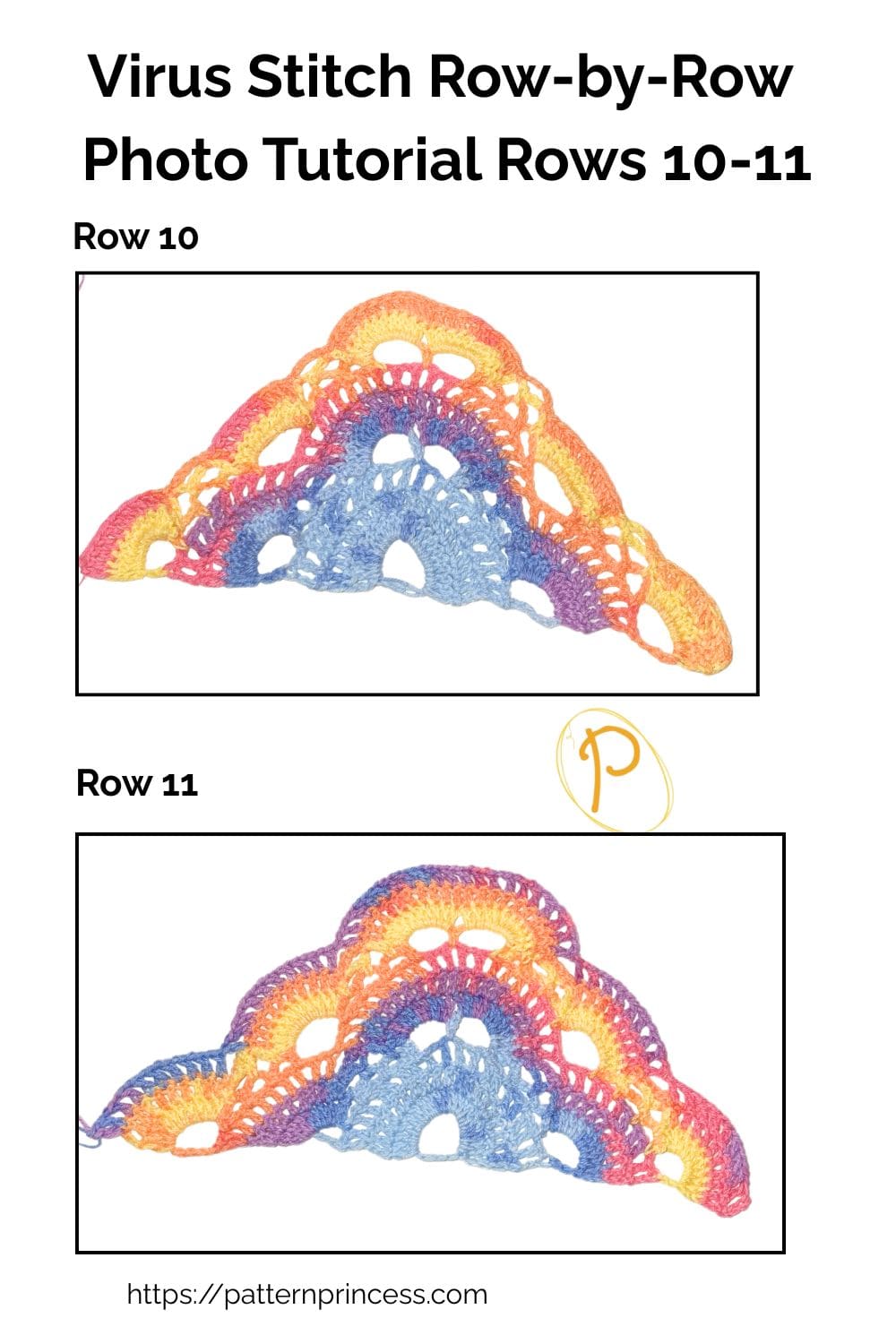
Row 10
Ch 3 (Counts as 1 DC). 1 DC in each of the next 9 STs of the Large CH-SP (10 DC).
1 SC in next Small CH-SP, CH 4, 1 SC in the next Small CH-SP. Next,1 DC in each of the next 10 STs of the Large CH-SP (10 DC). 1 SC in next Small CH-SP, CH 4, 1 SC in the next Small CH-SP.
Middle of row: 1 DC in each of the next 10 STs of the 2 Large CH-SP (20 DC).
1 SC in next Small CH-SP, CH 4, 1 SC in the next Small CH-SP. 1 DC in each of the next 10 STs of the Large CH-SP (10 DC). Next, 1 SC in next Small CH-SP, CH 4, 1 SC in the next Small CH-SP. 1 DC in each of the next 10 STs of the last Large CH-SP (10 DC). Turn
Row 11
Ch 4 (Counts as 1 DC and 1 CH). 1 DC in next ST, (CH 1, 1 DC) in all the DC STs of the Large CH-SP (10 DC). Skip the Small CH-SP. 1 DC in next ST, (CH 1, 1 DC) in all the DC STs of the Large CH-SP (10 DC). Skip the Small CH-SP.
1 DC into the first ST of the next Large CH-SP. (CH 1, 1 DC) in all DC of the 2 Large CH-SP STs (20 DC).
Skip the Small CH-SP. 1 DC in next ST, (CH 1, 1 DC) in all the DC STs of the Large CH-SP (10 DC). Skip the Small CH-SP. 1 DC into the first DC of the last Large CH-SP. (CH 1, 1 DC) in all the remaining DC (10 DC). Turn
Row 12 and Beyond
Continue the pattern by repeating Rows 8–11 until your hip scarf or shawl reaches the desired size.
Finishing
Use the tapestry needle to weave in the yarn tails on the back side of the work. I like to weave back and forth 3 to 5 times. Cut off the excess yarn.
YouTube Video Tutorials for the Virus Stitch Crochet Shawl & Hip Scarf
Would you like to see the stitch pattern in action? Follow along with the step-by-step video tutorials.
Virus Stitch Tutorial for Right Hand Crocheter
Virus Stitch Tutorial for Left Hand Crocheter
How to Block Your Virus Shawl
Blocking is the final step that gives the Virus Shawl its beautiful drape and opens up the lacework. It’s simple, and you only need a few basic supplies.
1. Soak the shawl Fill a basin with cool water and add a small amount of gentle wool wash (optional). Submerge the shawl completely and let it soak for about 15–20 minutes. This relaxes the fibers and helps the lace open up.
2. Remove excess water Lift the shawl out carefully, supporting its weight so it doesn’t stretch unevenly. Press out the water gently — do not wring or twist. Roll the shawl in a clean towel and press again to remove more moisture.
3. Pin the shawl into shape Lay the shawl on blocking mats or a clean, flat surface. Shape it into a neat triangle, smoothing out the Virus Stitch fans. Use rust‑proof pins or blocking wires along the edges to open the lace and create crisp points. Take your time here — this step defines the final look.
4. Let it dry completely Allow the shawl to air‑dry fully before removing the pins. Once dry, the lace will stay beautifully open and the shawl will have a soft, flowing drape.

Is the Virus Stitch Easy to Crochet?
The Virus Stitch may look complicated, but it is made using basic crochet stitches combined in a repeating pattern. If you’re comfortable with stitches such as the chain stitch, slip stitch, single crochet, and double crochet, you can learn to make this stitch with a little practice.
The first few pattern repeats may take some concentration as you learn how the sections fit together. However, once you understand the repeating sequence, the stitch becomes much more intuitive.
I would consider this stitch intermediate.

You can find Victoria crocheting, quilting, and creating recipes. She has cooked in restaurants for over 20 years, including many larger parties. She learned to crochet when she was just 11 years old and has been crocheting ever since; over 50 years now. Over 40 years ago, she loved her first class in sewing and continues to hone her skills in quilting. Many have enjoyed the handmade gifts over the years. In her professional career, she has worked in management in a wide variety of businesses including higher education as a dean of a division. All the while attending college part-time to achieve her doctorate in higher education with an emphasis in e-learning.
Stay connected with Pattern Princess
Add Pattern Princess as a preferred source in Google Search to make it easier to find our crochet patterns, recipes, quilt patterns, and other creative projects when you're looking for something new to make.
