
At first glance, stitch multiples can seem confusing. But once you understand this simple concept, crochet patterns become much easier to read and customize.
If you have ever opened a crochet pattern and seen instructions like “chain a multiple of 4 + 2” or “work over multiples of 6 stitches,” you may have wondered what that actually means.
Learning how stitch multiples work gives you the freedom to make a scarf wider, resize a blanket, or experiment with stitch patterns on your own. It is one of the most useful skills a beginner crocheter can learn.
In this guide, we will explain crochet stitch multiples in the simplest way possible, with clear examples, a handy chart, and practice exercises to help everything click.
What Are Stitch Multiples in Crochet?
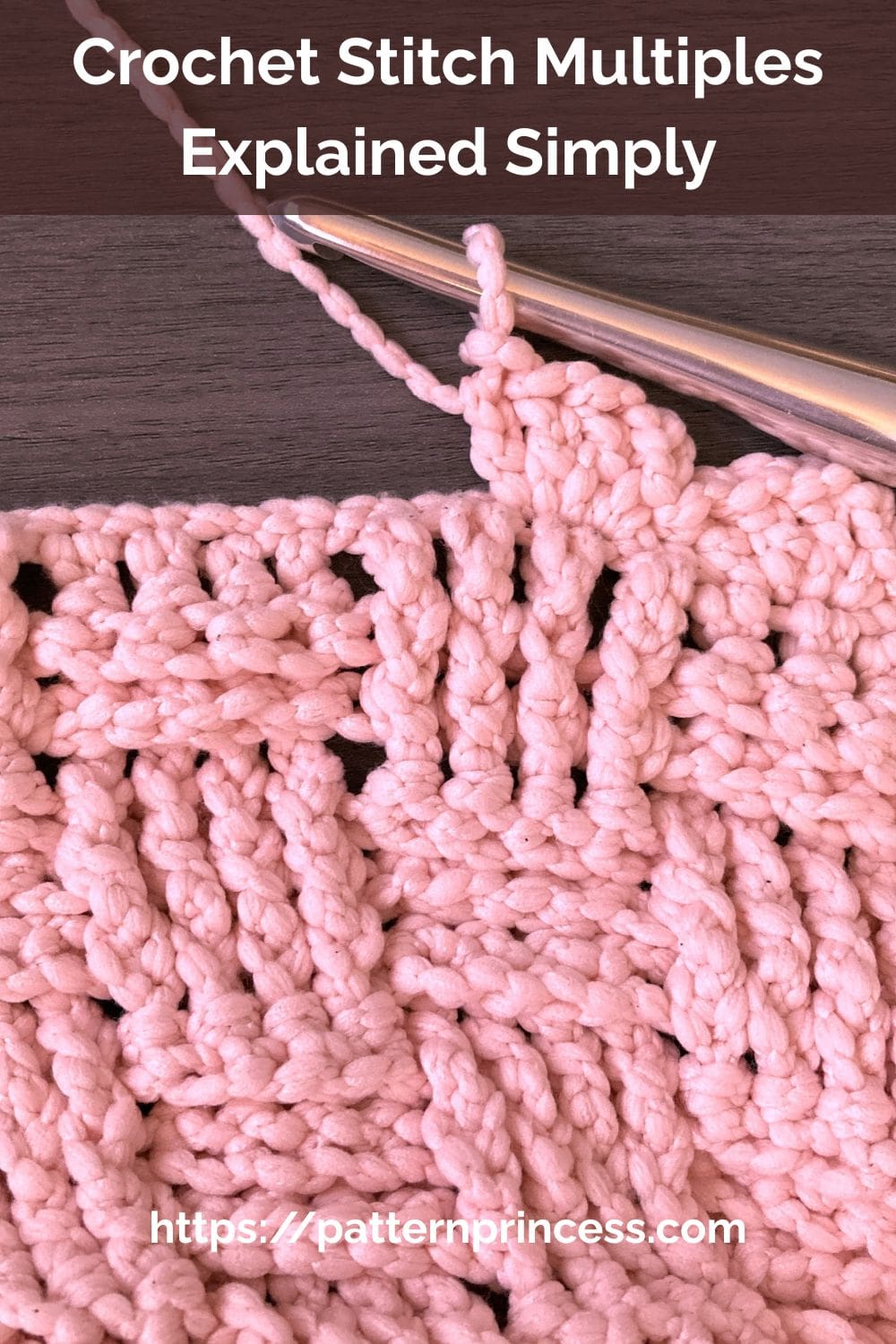
A stitch multiple is the number of stitches needed to repeat a particular crochet pattern.
Many stitch patterns are made up of groups of stitches that repeat across the row. The stitch multiple tells you how many stitches are required for each repeat.
For example, if a pattern repeat uses 4 stitches, the stitch multiple is 4.
That means your starting chain might be:
- 4 stitches
- 8 stitches
- 12 stitches
- 16 stitches
- 20 stitches
As long as the total is divisible by 4, the pattern will work.
Table of contents
Why Stitch Multiples Matter
Understanding stitch multiples helps you:
- Read crochet patterns with confidence
- Adjust project widths
- Resize blankets and scarves
- Design your own simple patterns
- Troubleshoot when stitch counts seem off
Once you understand the concept, you will no longer feel intimidated by instructions such as “multiple of 5 + 2.”
Understanding the Basic Formula
Most crochet stitch multiples are written in one of these ways:
- Multiple of 4
- Multiple of 6 + 2
- Multiple of 5 + 3
The first number tells you the size of the repeating stitch pattern.
The second number (after the plus sign) adds extra stitches needed for:
- Edge stitches
- Turning chains
- Balance stitches
- Pattern symmetry
Multiple of 4
This means the stitch pattern repeats every 4 stitches.
Valid starting chains include:
- 4
- 8
- 12
- 16
- 20
- 24
If your chain is one of these numbers, the pattern repeat will fit perfectly across the row.
Multiple of 4 + 2
This means:
- Choose any number divisible by 4.
- Add 2 extra stitches.
Examples:
- 4 + 2 = 6
- 8 + 2 = 10
- 12 + 2 = 14
- 16 + 2 = 18
- 20 + 2 = 22
These totals will work for a stitch pattern requiring a multiple of 4 plus 2 additional stitches.
Easy Real-Life Example
Suppose you want to crochet a blanket using a stitch pattern that requires a multiple of 6 + 3.
You decide to use 5 repeats.
- 6 × 5 = 30
- 30 + 3 = 33
Your starting chain should be 33 stitches.
Crochet Stitch Multiples Cheat Sheet
| Pattern Says | Chain Numbers That Work |
| Multiple of 2 | 2, 4, 6, 8, 10 |
| Multiple of 3 | 3, 6, 9, 12, 15 |
| Multiple of 4 | 4, 8, 12, 16, 20 |
| Multiple of 4 + 2 | 6, 10, 14, 18, 22 |
| Multiple of 5 + 1 | 6, 11, 16, 21, 26 |
| Multiple of 6 + 3 | 9, 15, 21, 27, 33 |
| Multiple of 8 + 4 | 12, 20, 28, 36, 44 |
How to Calculate Any Stitch Multiple
Use this simple formula:
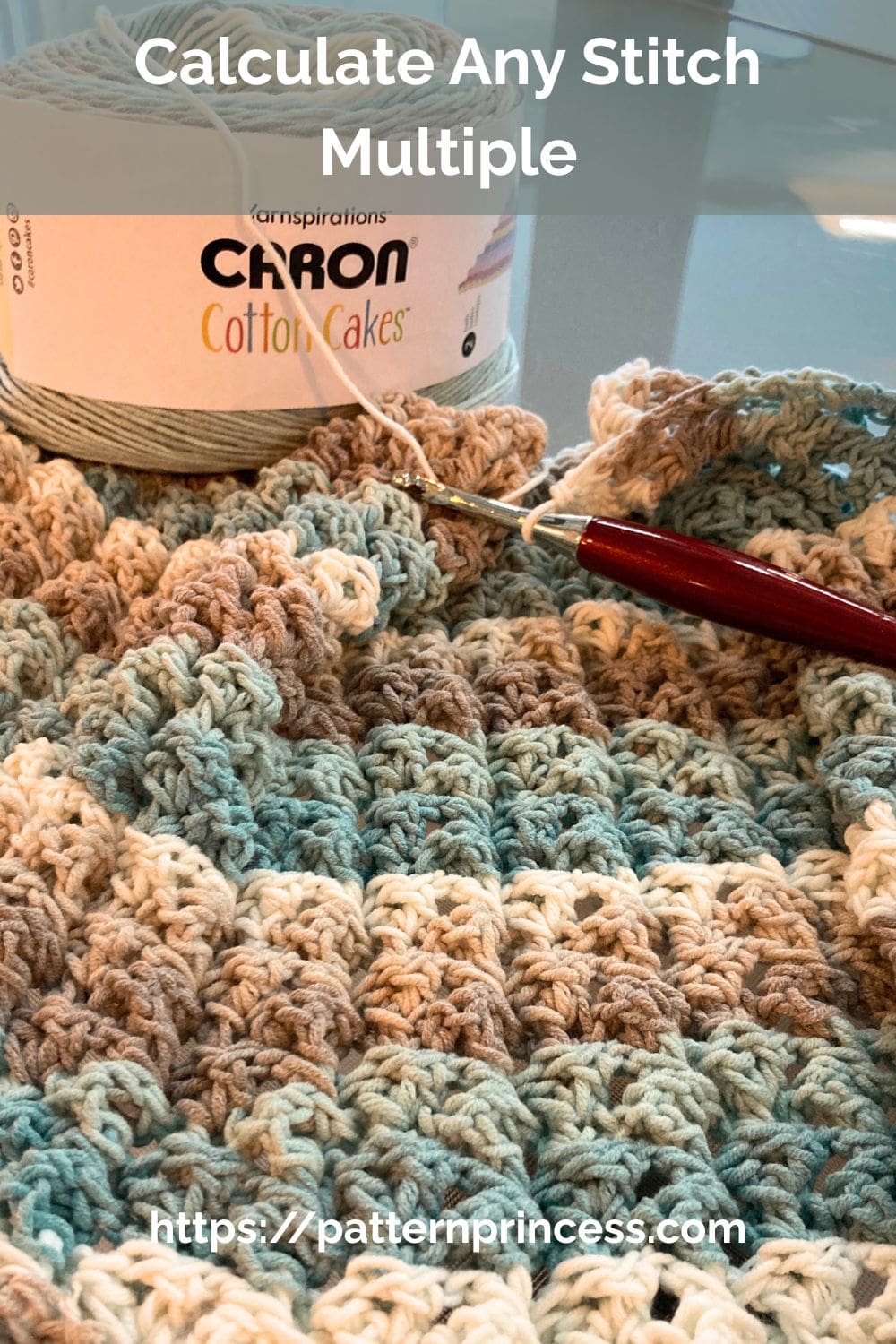
(Stitch Multiple × Number of Repeats) + Extra Stitches = Starting Chain
For example:
- Stitch multiple = 5
- Number of repeats = 7
- Extra stitches = 2
Calculation:
- 5 × 7 = 35
- 35 + 2 = 37
Your starting chain should be 37 stitches.
Common Crochet Stitches That Use Multiples
Many popular stitches rely on stitch multiples, including:
- Single Crochet
- Half Double Crochet
- Double Crochet
- Shell Stitch
- V-Stitch
- Ripple Stitch
- C2C Crochet
Practice Exercises
Example 1
Pattern says: Multiple of 3 + 2
Use 6 repeats.
- 3 × 6 = 18
- 18 + 2 = 20
Starting chain = 20
Example 2
Pattern says: Multiple of 7 + 1
Use 4 repeats.
- 7 × 4 = 28
- 28 + 1 = 29
Starting chain = 29
Tips for Beginners
- Count your starting chain carefully.
- Write down your calculations before chaining.
- Make a small swatch to test the stitch pattern.
- Double-check whether turning chains are included in the count.
- Use stitch markers to keep track of repeats.
What does “multiple of 4” mean in crochet?
Your starting chain must be divisible by 4, such as 8, 12, 16, or 20 stitches.
What does the “+ 2” mean?
These are extra stitches added for turning chains, borders, or pattern balance.
Can I change the size of a pattern using stitch multiples?
Yes. Once you know the stitch multiple, you can add or remove repeats to make your project wider or narrower.
Are turning chains included?
It depends on the pattern. Always read the instructions carefully.
Related Beginner Crochet Tutorials
Ready to expand your crochet skills? These helpful guides cover other essential techniques every beginner should know.
- How to Read a Crochet Pattern
- How to Read a Yarn Label
- Blanket Size Guide
- Crochet Gauge Explained for Beginners
- How to Join Yarn
Unraveling Stitch Multiples
Crochet stitch multiples may look intimidating at first, but they are simply a way to organize repeating stitch patterns.
Once you understand how they work, you will be able to read patterns more confidently, adjust project sizes, and even create your own custom designs.
This is one of those “aha” moments that helps beginner crocheters move from following instructions step by step to truly understanding the craft.
Keep this cheat sheet handy, practice with a few examples, and before long, stitch multiples will feel completely natural.

You can find Victoria crocheting, quilting, and creating recipes. She has cooked in restaurants for over 20 years, including many larger parties. She learned to crochet when she was just 11 years old and has been crocheting ever since; over 50 years now. Over 40 years ago, she loved her first class in sewing and continues to hone her skills in quilting. Many have enjoyed the handmade gifts over the years. In her professional career, she has worked in management in a wide variety of businesses including higher education as a dean of a division. All the while attending college part-time to achieve her doctorate in higher education with an emphasis in e-learning.
Stay connected with Pattern Princess
Add Pattern Princess as a preferred source in Google Search to make it easier to find our crochet patterns, recipes, quilt patterns, and other creative projects when you're looking for something new to make.
